
Knife Skills That Actually Matter: Faster, Safer Chopping (and Why Cuts Change Taste)
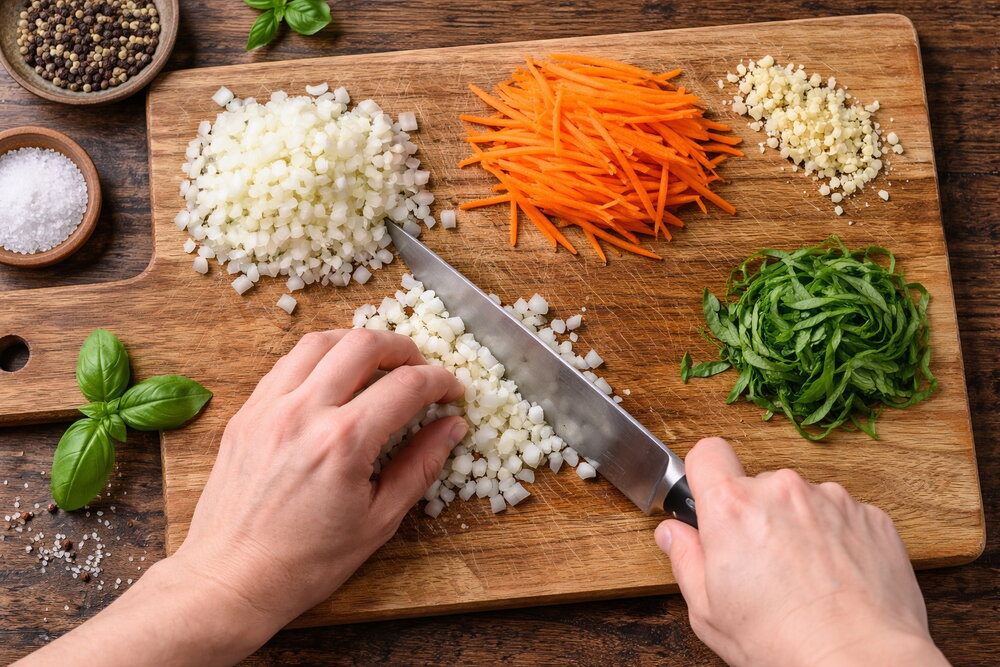
Most people don’t need fancy chef tricks. You need the handful of knife skills that:
- make you faster without rushing
- keep your fingers out of danger
- and make food cook more evenly (which literally changes taste)
This is the no-fluff guide to cutting like a confident home cook.
1) The two grips that fix everything
The knife hand: the pinch grip
Hold the blade between thumb and index finger (right where blade meets handle), then wrap the rest around the handle.
Why it matters: more control, less wobble, safer cuts, less fatigue.
The “claw” hand (your guard hand)
Curl fingertips under, knuckles forward. The knife glides against your knuckles.
Why it matters: your knuckles become the “fence.” Fingertips stay tucked.
Speed secret: speed comes from rhythm + control, not chopping faster.
2) Your cutting board setup (tiny change, big safety)
- Put a damp towel or non-slip mat under the board.
- Keep a “trash bowl” (peels, onion ends) on your counter.
- Clear a landing zone for chopped food.
Less clutter = fewer accidents.
3) Your knife doesn’t need to be fancy—it needs to be sharp
A dull knife is more dangerous than a sharp one because it slips.
Easy sharpness test: can it slice a tomato skin cleanly without crushing?
- If no: sharpen or get it sharpened.
Bonus: sharper knife = cleaner cuts = better texture.
4) The 3 cuts you’ll use constantly (master these)
A) Slice
Thin or thick slices (cucumber, onions, mushrooms).
Best for: quick cooking, sautéing, sandwiches.
B) Dice
Small cubes for even cooking (onion, potatoes, carrots).
Best for: soups, stews, fried rice.
C) Mince
Tiny pieces (garlic, ginger, herbs).
Best for: sauces, marinades, dressings.
If you can slice, dice, and mince safely, you can cook 90% of recipes.
5) The onion: the most useful thing to learn
Quick safe onion dice
- Cut onion in half pole-to-pole. Peel.
- Lay flat side down.
- Make horizontal cuts toward the root (don’t cut through root).
- Make vertical cuts.
- Slice across to dice.
Why it matters: onion size controls how it behaves:
- Small dice melts into sauces (sweet base)
- Big chunks stay distinct (texture + bite)
6) Garlic: mince it without smashing your fingers
- Smash clove lightly with the side of the knife → peel slips off.
- Slice, then mince.
- Add a pinch of salt and “paste” it with the knife if you want it to dissolve.
Taste difference:
- Garlic paste = stronger, spreads through dish
- Sliced garlic = milder, little bursts of flavor
Why cuts change taste (this is the fun part)
Surface area = intensity
Smaller pieces = more surface area = more browning, faster flavor release.
- Minced onions sweeten faster and disappear
- Big onion wedges stay sharper and crunchier
Cut size changes cooking time (and texture)
Even cuts cook evenly. Uneven cuts give you half-mushy, half-raw.
- Thin carrots → sweeter, softer
- Thick carrots → firmer, more “carrot flavor”
Cutting can change heat/spice perception
- Thinly sliced chilies spread heat quickly
- Large chili pieces give “hot pockets” (uneven spice)
Herbs: chopped vs torn
- Chopped herbs release oils fast (more flavor now, can bruise)
- Torn herbs stay fresher-looking and taste cleaner
The 6 cut shapes worth knowing (home cook edition)
- Small dice (onion base, soups, sauces)
- Medium dice (potatoes, veg for roasting)
- Julienne (thin matchsticks; stir-fries, salads)
- Chiffonade (thin ribbons; basil, spinach)
- Bias slice (diagonal slices; looks fancy, cooks evenly)
- Rough chop (rustic soups, sheet-pan veg)
You don’t need more than these.
Speed without danger: 7 habits that actually make you faster
- Keep your knife tip on the board for rocking cuts (herbs, garlic).
- Move food with the back of the knife, not the sharp edge.
- Work in batches (all onions, then all peppers).
- Make flat surfaces (halve round things so they don’t roll).
- Let the knife do the work—don’t force it.
- Reset your claw hand often (fatigue makes fingers creep forward).
- Stop when distracted. Seriously.
Common knife mistakes (and quick fixes)
- Board sliding: damp towel underneath.
- Food rolling: cut a flat side first.
- Crushed tomatoes/onions: knife is dull or you’re pushing too hard.
- Uneven dice: slow down and focus on consistent slice thickness first.
Mini practice plan (10 minutes, 3 days)
Day 1: onions (small dice)
Day 2: carrots (matchsticks + medium dice)
Day 3: herbs (chiffonade) + garlic mince
You’ll feel the difference fast.